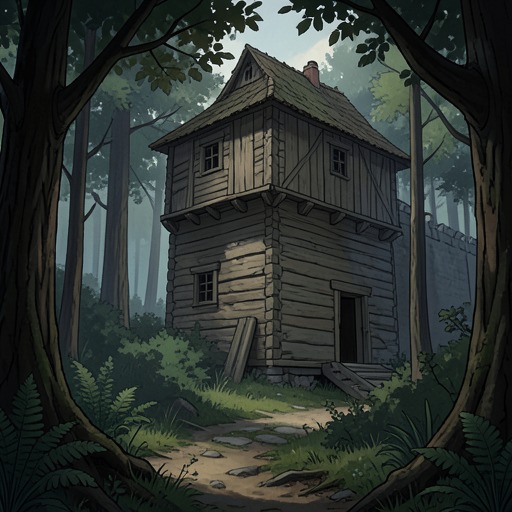
Matt’s Fort is split in two by lightning
Ronja, the Robber's DaughterMatt’s Fort is split in two by lightning on the night Ronia is born, a physical rupture that reshapes the ancient stronghold and becomes the perilous landmark at the center of Ronia and Birk’s first encounter. The disaster divides the fortress, but not the life within it: the family and robbers adapt, while the chasm remains both a danger to heed and a challenge Ronia will eventually approach for herself.
The lightning strike and the divided fortress
The lightning’s blow is confirmed the next morning. Matt’s ancient fortress, high on Matt’s Mountain, has been cleft from its highest battlements to the deepest dungeon vaults. Two halves now stand with a chasm between them. The scale of the damage makes the birth of Matt’s daughter coincide with the destruction of the stronghold’s old physical unity; Lovis, holding the newborn beside the shattered wall, remarks on the grand start to Ronia’s young life.
Matt first rages at what has happened to his forefathers’ fortress, but his anger does not last. He finds reasons to take comfort in practical adjustments: the split has removed some of the fortress’s confusing passages, cellar pits, and rubbish, and perhaps no one will again get lost inside. His example is Noddle-Pete, who once wandered for four days before finding his way back to the great stone hall, guided at last by the robbers’ noise. The broken building is not only a calamity; it is also, in Matt’s rueful account, less sprawling than before.
A damaged home made livable
The chasm does not drive Matt’s household from the fortress. Matt says they have never used all of it and will continue living in their familiar hall, bedrooms, and tower rooms. One loss does particularly irritate him: the outhouse is stranded on the far side of the gap, leaving anyone who needs it to wait until a replacement can be built. The inconvenience is soon dealt with, and ordinary life resumes in Matt’s Fort.
That return to routine is not quite a return to the old household. Ronia is now there, growing from a baby into a child whose crawling delights Matt and his twelve robbers so completely that, in Lovis’s view, they become gentler and milder but also neglect their work. The contrast gives the split fortress two meanings: it is lasting damage to an inherited home, yet the home continues to hold a daily life that changes with Ronia’s arrival.
The chasm as warning and challenge
As Ronia grows, the gap becomes part of the story Matt repeatedly tells about the night she was born. His recollection fixes its danger in a vivid refrain: “Death and destruction, what a crack!” He reminds her that there were two forts instead of one, with a chasm between them, and warns her to watch out for Hell’s Gap. What began as a family account of catastrophe therefore also gives Ronia a name for the perilous space and a warning she will have to interpret for herself.
After hiding from the Wild harpies, Ronia decides to use the hours before nightfall to climb onto the roof and look for Hell’s Gap. She has been on the roof before but has never approached the unguarded chasm. Crawling forward on her stomach, she peers into its depth, drops a loose stone, and hears it land far below. The gap is not especially wide, she observes, and one good jump might cross it; that thought turns the inherited warning into a test she wants to consider and practice.
The gap becomes a meeting place
From the roof, Ronia sees someone about her own size sitting on the far side, his legs dangling over Hell’s Gap. The chasm has unexpectedly become a boundary between two children, not simply a scar through the fortress. Later, when Birk slips on a loose stone after landing and falls into the depths, Ronia sees him standing on a small projection beneath her, with only enough room for his feet and the abyss below. Both understand that he cannot escape unaided. Her warning to hang on, and his wry answer that there is little else he can do, turn the old disaster into the immediate condition of their first rescue.
The chasm’s narrative force lies in this change of scale. It begins as a lightning strike that splits an ancestral fortress from top to bottom, then becomes a domestic inconvenience Matt can address, a danger preserved in his repeated warning, and finally the setting for Ronia and Birk’s risky meeting and mutual peril. The building never becomes whole again, but its rupture opens a crossing between the children: the gap that divides the two halves is also the space across which their relationship begins.